Mudéjar Architecture in the Alcázar: The Tile Detail Most Visitors Walk Past
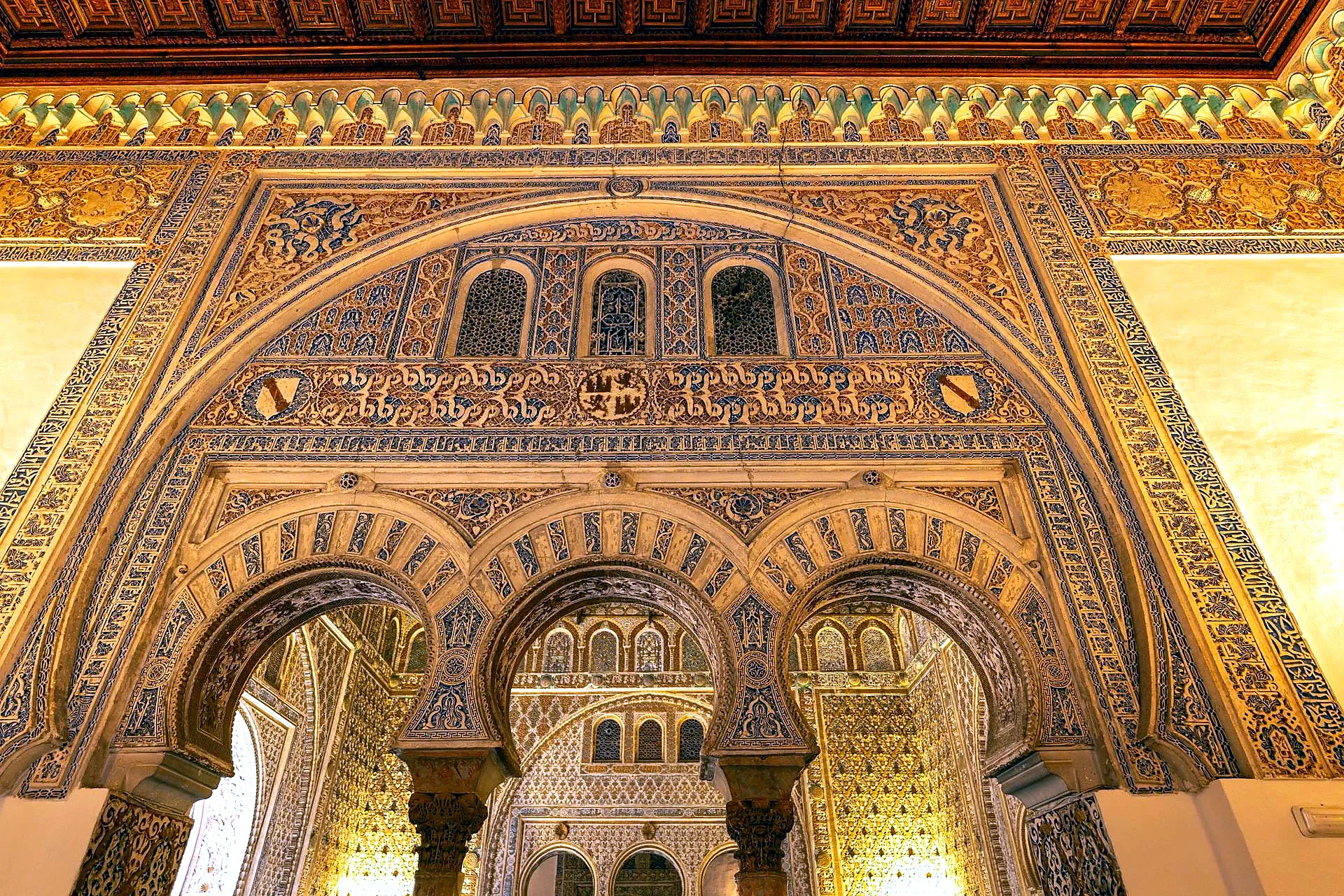
In the Patio de las Doncellas at the Real Alcázar, there is a geometric border running along the lower walls at knee height. Most visitors photograph what is above it — the carved stucco arches, the upper arcade, the pool that reflects the whole composition. What is at knee height is older, and it tells a different story. The tile border is 14th century Mudéjar work, installed when Pedro I commissioned the palace in 1364. The stucco above it is 16th century, added under the Habsburg kings who came after. The patio is not one building — it is a conversation across two hundred years between builders who understood what came before them. Mudéjar architecture in the Alcázar is this conversation made visible, and most visitors walk past it without knowing what they are looking at.
What Mudéjar Architecture Is — and Why the Alcázar Is Its Greatest Expression
Mudéjar is not a single architectural style in the way Gothic or Baroque are single styles. It is the name given to work produced by Muslim craftsmen — mudéjares, from the Arabic mudajjan, meaning “the domesticated ones” — who remained in Christian-controlled Iberia after the Reconquista and continued practising their tradition for Christian patrons. The result is a hybrid that belongs to neither culture cleanly: Islamic geometries executed under Christian commission, mosque-derived ornamental vocabularies applied to palace apartments, synagogues and churches.
The Alcázar’s Mudéjar section was commissioned in 1364 by Pedro I of Castile, who specifically requested craftsmen from the Nasrid court in Granada — the same workshops producing the contemporary sections of the Alhambra — as well as from Toledo’s established Mudéjar ateliers. Pedro was not converting to Islam; he was acquiring the most sophisticated decorative tradition available in 14th century Iberia. The craftsmen brought their full repertoire with them.
What makes the Alcázar’s Mudéjar work distinct from other Mudéjar buildings in Spain is the scale and ambition of the commission. Most Mudéjar buildings in Toledo, in Aragón, in Castile, use the tradition selectively — a decorated ceiling here, a tiled dado there. The Alcázar’s Pedro I palace applies the full vocabulary systematically across an interconnected suite of rooms and courtyards, creating the most complete Mudéjar interior complex in existence.
✦ LUCÍA’S INSIGHT
The geometric tile border in the Patio de las Doncellas uses a pattern based on a twelve-pointed star as its foundational module — the same module appears in the Alhambra’s tile work from the same period. Look at the lower dado level in any major room in the Pedro I palace and find the twelve-pointed star. Once seen, it is impossible to unsee, and it reappears throughout the Alcázar in different scales and colourways. This is not decoration applied to a surface — it is a mathematical system generating infinite variation from a single rule.
The Geometric System: What the Tiles Are Doing
Mudéjar tile work operates on principles derived from Islamic geometric art, which prohibits figurative representation and instead explores the infinite possibilities of pattern. The craftsmen working in the Alcázar were trained in a tradition that understood geometry as a form of theological argument — the infinite divisibility and recombination of the basic shapes mirroring the infinite attributes of God. A Christian patron commissioning this work in 1364 may not have shared the theology, but he understood the prestige of the tradition.
The geometric system used in the Alcázar’s tilework is based on the subdivision of the circle. A circle is divided into equal parts — six, eight, ten, twelve — and the resulting polygons are then combined, rotated, and interlaced to create star patterns of increasing complexity. The twelve-pointed star in the Patio de las Doncellas requires a circle divided into twelve equal parts; the resulting pattern generates triangles, squares, hexagons and the star itself simultaneously. The tile cutter’s skill lay in cutting each piece to fit within this geometry with tolerances measured in millimetres.
The colour conventions are equally systematic. Deep cobalt blue and white tiles form the foundational layer; green and ochre tiles occupy the middle register; the star points typically read in the lightest value. In the Salón de Embajadores — the throne room — the dado tiles run to approximately 2.5 metres height before the carved stucco begins, creating a lower zone of geometric precision that anchors the more organic carved surfaces above.
The Carved Stucco: A Different Language, the Same Argument
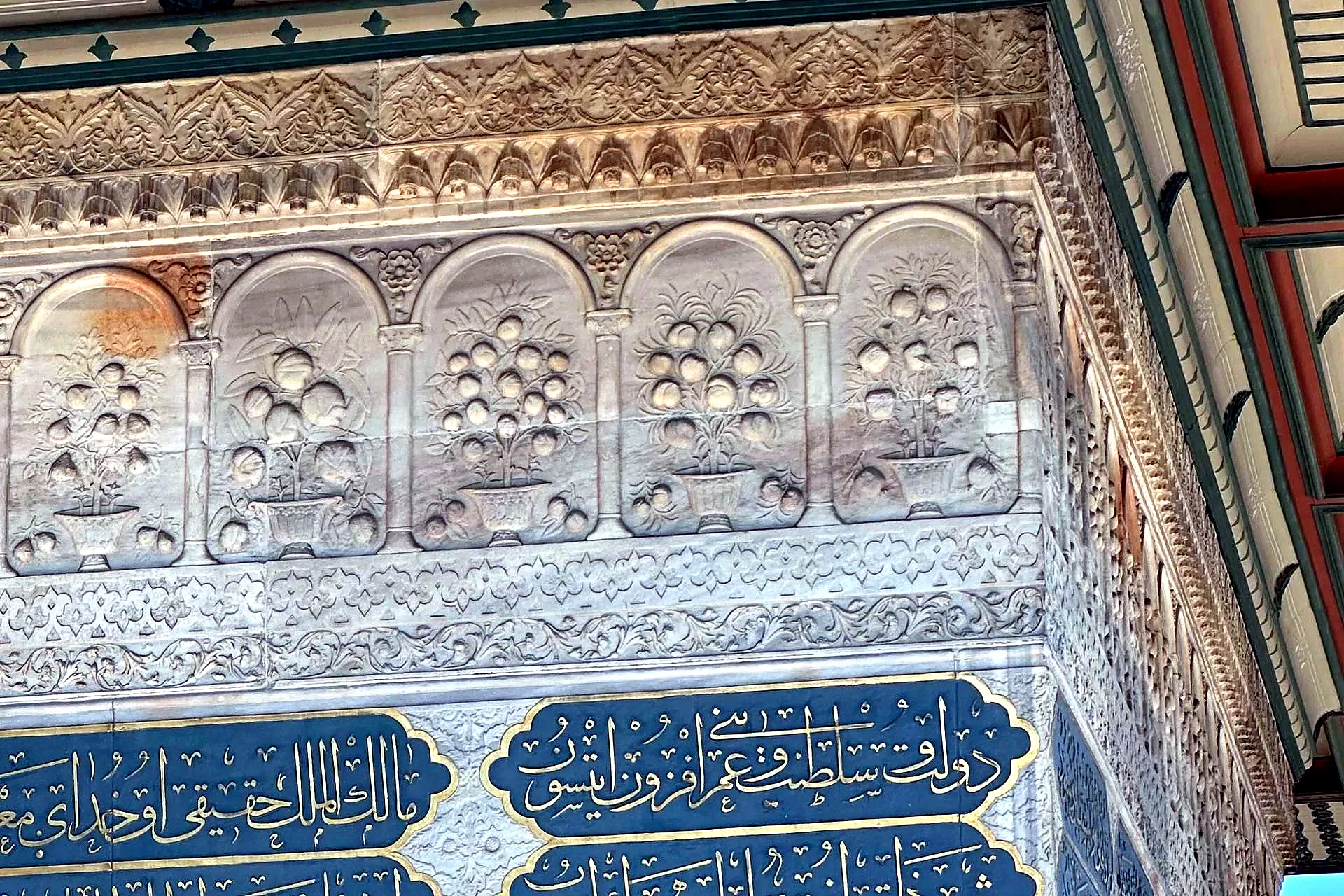
Above the tile dado, Mudéjar architecture deploys carved stucco in a vocabulary equally systematic in its underlying logic. The epigraphic bands — inscriptions in Arabic that run as friezes through the main rooms — are a defining feature of the Pedro I palace that confuses visitors who understand that a Christian king commissioned the work. The inscriptions in the Salón de Embajadores include phrases from the Quran and declarations that can be read as statements of Nasrid royal ideology. Pedro I apparently requested them alongside purely decorative inscriptions, understanding them as markers of prestige and cultural sophistication rather than as religious statements.
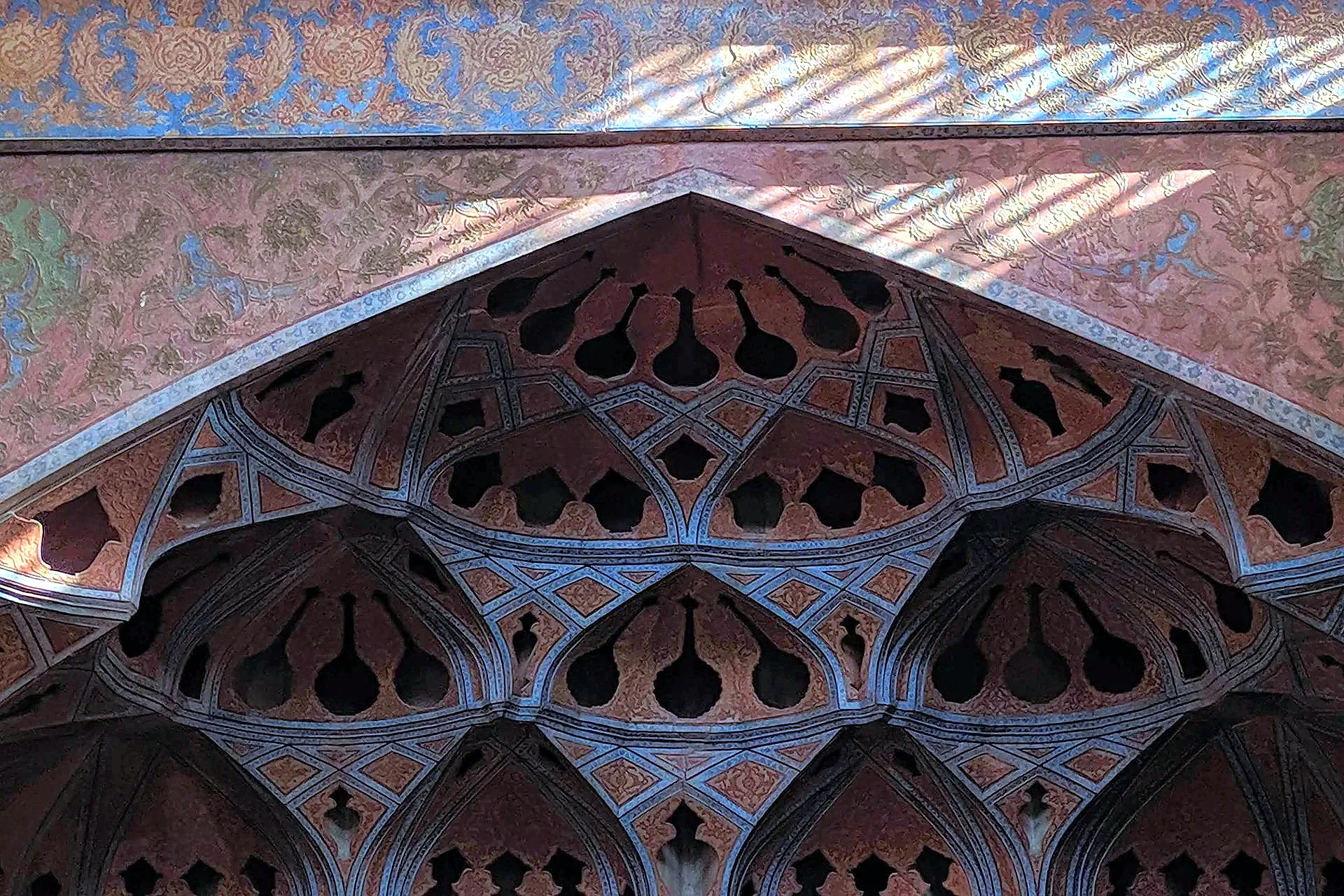
The muqarnas ceiling in the Salón de Embajadores is the most technically accomplished single element in the Alcázar. Muqarnas — the stalactite-like bracketing system used in Islamic architecture to create transitions between geometric and circular forms — requires three-dimensional geometric thinking that modern architects find difficult to reconstruct without computational tools. The Alcázar’s muqarnas dome, completed in 1366, uses 360 individual facets arranged in concentric rings. The number is not accidental.
Where to See the Best Mudéjar Work in the Alcázar
The Patio de las Doncellas provides the most complete experience of Mudéjar as a total design system — tiles, stucco, arcades and water working together as a unified composition. Arrive early and spend time at the far end looking back toward the entrance arch; this is the view that the original design intended as its primary axis.
The Salón de Embajadores offers the finest individual elements: the muqarnas dome, the epigraphic friezes, the height and proportion of the room that creates a quality of silence unusual in a palace interior. The double-arched windows opening onto the Patio de la Montería to the north are original 14th century work.
The Patio de las Muñecas — the private courtyard beyond the Salón de Embajadores — shows the tradition at its most intimate. The tile dado here uses a smaller module than the Patio de las Doncellas, creating a denser, more jewel-like effect appropriate to the private apartments. The carved stucco columns are partially original, partially 19th century restoration — the restorations are distinguishable by their whiter tone and slightly less deep carving.
For a specialist architecture tour focused specifically on the Mudéjar layer and the Islamic architectural tradition it derives from, small-group options are available through GetYourGuide that cover the Alcázar with guides trained specifically in Andalusian architectural history.
FAQ
What is Mudéjar architecture?
Mudéjar architecture is the style produced by Muslim craftsmen working under Christian patronage in medieval Iberia, following the Reconquista. It combines Islamic decorative vocabularies — geometric tile work, carved stucco, muqarnas ceilings, epigraphic friezes — with Christian building programmes. The Real Alcázar in Seville contains the most complete Mudéjar interior complex in existence, commissioned by Pedro I of Castile in 1364.
Where can I see Mudéjar architecture in Seville?
The Real Alcázar is the primary site, specifically the Pedro I palace (1364) with its Patio de las Doncellas, Salón de Embajadores and Patio de las Muñecas. The Iglesia de Santa Ana in Triana and several parish churches in the Santa Cruz district also contain significant Mudéjar elements. Toledo has comparable examples outside Seville, particularly the Sinagoga del Tránsito and the Monasterio de Guadalupe.
How is the Alcázar’s Mudéjar style different from the Alhambra?
The Alhambra is Nasrid architecture — produced by Muslim craftsmen for Muslim sultans within a Muslim kingdom. The Alcázar’s Mudéjar work was produced by craftsmen from the same tradition for a Christian king. The vocabulary is related — both use geometric tile work, muqarnas, stucco carving — but the Alhambra applies the tradition with full cultural authority across a longer building period (13th–14th century), while the Alcázar’s Pedro I palace represents a single compressed commission that uses the Nasrid vocabulary as an imported prestige language.
Do I need an architecture guide to appreciate the Alcázar?
The Alcázar is worth visiting without specialist knowledge — its visual quality is immediately apparent. But understanding the geometric system underlying the tile work, the significance of the Arabic inscriptions in a Christian palace, and the specific technical achievements of the muqarnas dome transforms what can be an overwhelming visual experience into a legible one. A specialist architecture guide adds considerably; so does reading the history in advance of visiting.
Related Posts
- Real Alcázar Seville: Tickets, Skip-the-Line Tours and Complete Visitor Guide
- Real Alcázar Tickets 2026: How to Book, What It Costs and Why They Sell Out Fast
- History of the Real Alcázar: What Each Courtyard Was Actually Built For
- Real Alcázar vs Alhambra: Which Moorish Palace Is the Better Visit?
- Best Tours in Seville 2026: Walking Tours, Bike Tours, Night Tours and Local Workshops