History of the Real Alcázar: What Each Courtyard Was Actually Built For
In the Patio del León — the first courtyard most visitors enter through the Puerta del León gate — there is a section of wall on the eastern side that belongs to a 10th century Islamic palace. It is older than anything in the Alhambra. Most visitors walk past it on their way to the Pedro I rooms, which is understandable: the Mudéjar decoration further in is more immediately legible, more visually dramatic. But the wall in the Patio del León is older, and understanding it changes the entire building. The history of the Real Alcázar is not the story of one palace — it is the story of at least six distinct building campaigns across eleven centuries, each one built on, around, or partially over what came before it. What each courtyard was actually built for is the question this post answers.
The Islamic Foundation: 10th–11th Century
The earliest structures on the Alcázar site date to the reign of Abd al-Rahman III, the first Caliph of Córdoba, who ordered the construction of a dar al-imara — a governor’s residence — in Seville around 913 CE. This original structure occupied the elevated ground above the Guadalquivir river bend that made the site strategically significant: the same topographical logic that had attracted Roman settlement in the same location centuries earlier.
The Abbadid dynasty, who ruled Seville as a taifa kingdom after the Caliphate’s collapse in the early 11th century, significantly expanded the complex. The poet-king al-Mu’tamid (ruled 1069–1091) made the Alcázar his primary residence and court. Literary sources from the period describe gardens, pools, and ceremonial halls of considerable ambition. Almost none of this survives architecturally above ground level — the subsequent Christian campaigns rebuilt too thoroughly — but archaeological investigations conducted during 20th century restoration work confirmed the existence of these earlier phases in the foundations.
The fragment of 10th century wall visible in the Patio del León is the most accessible surviving element of this Islamic period. Its construction technique — small irregular stones set in a specific mortar mix — distinguishes it clearly from the 12th century Almohad construction and the later Mudéjar work. Without knowing what to look for, it reads as simply old masonry.
The Almohad Period: 12th Century
When the Almohad dynasty took control of al-Andalus from North Africa in the mid-12th century, Seville became the most important city in their Iberian territories. The Almohad caliph Abu Ya’qub Yusuf I (ruled 1163–1184) commissioned the construction of the Giralda tower — originally a minaret for the Great Mosque of Seville, on the site now occupied by the Cathedral — and significantly rebuilt the Alcázar complex.
The Patio del Yeso survives from this Almohad phase and is the most intact 12th century Islamic structure remaining in Seville. Its carved plasterwork arcade — a blind arcade of interlaced arches with geometric interlace in the spandrels — represents the Almohad decorative tradition at high quality, though without the extreme elaboration of the later Nasrid and Mudéjar work. The proportions of the patio are spare and precise in a way that the later Pedro I courtyards, with their denser decorative programmes, are not.
✦ LUCÍA’S INSIGHT
The Patio del Yeso is consistently overlooked by visitors focused on reaching the Pedro I palace. It sits off the main circulation route and is easy to miss if following a tour group or moving quickly through the complex. Worth seeking out specifically: enter through the garden gate from the Patio de la Montería and look for the carved plasterwork arcade. The quality of the 12th century carving is immediately apparent and the patio is almost always quieter than the main Mudéjar rooms.
The Christian Reconquista and Fernando III: 13th Century
Ferdinand III of Castile took Seville from the Almohads in 1248, ending Islamic political control of the city. The Alcázar became a royal residence of the Castilian crown. Fernando III and his son Alfonso X (Alfonso the Wise, ruled 1252–1284) used and adapted the existing Islamic structures rather than demolishing them — a practical decision, since the buildings were in good condition, and also a cultural one: Alfonso X, whose court produced trilingual literary and scientific texts in Arabic, Hebrew and Castilian, was deeply engaged with the Islamic intellectual tradition he had inherited.
Alfonso X added the Gothic hall now called the Sala de Justicia, which survives as a relatively plain vaulted room compared to the decoration that surrounds it. Its proportions follow Gothic conventions from northern Europe; the decorative elements use Mudéjar craft vocabulary. It is the architectural equivalent of Alfonso’s trilingual manuscripts: a convergence of traditions in a single object.
Pedro I and the Mudéjar Palace: 14th Century
The construction campaign that defines the Alcázar in the popular imagination was ordered by Pedro I of Castile — known as “el Cruel” by his enemies and “el Justiciero” by his supporters — who commissioned a new palace in 1364. Pedro specifically requested craftsmen from the Nasrid court in Granada and from Toledo’s established Mudéjar workshops. The result is the most ambitious Mudéjar commission in the history of the tradition.
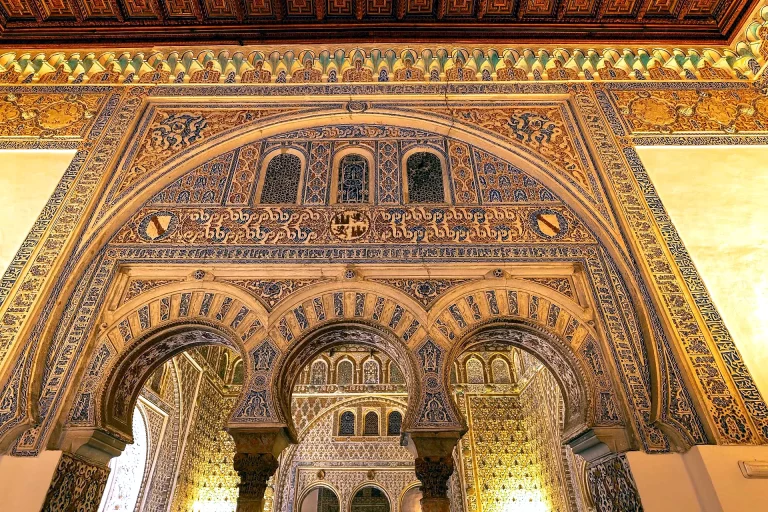
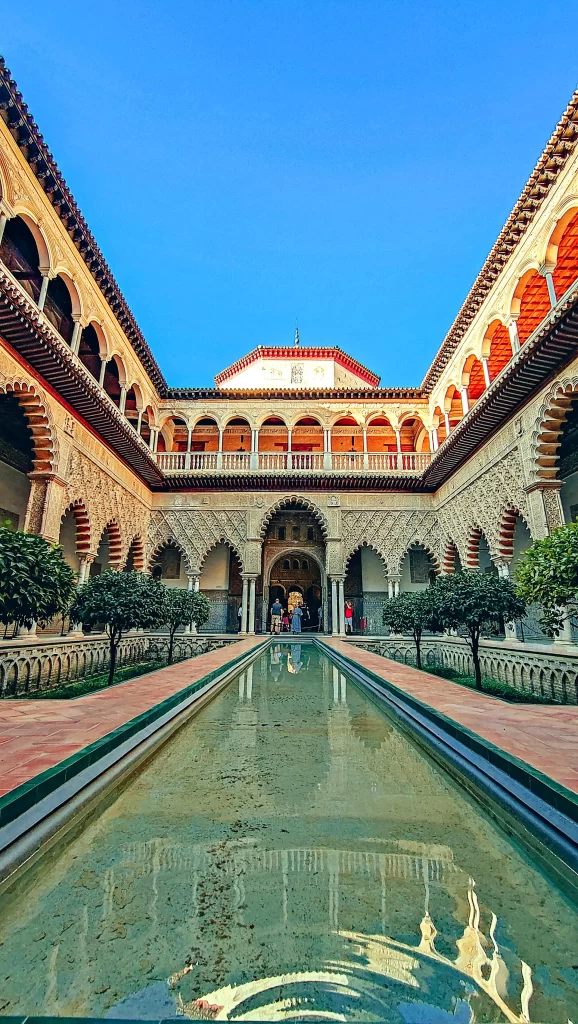
The Patio de las Doncellas was the central courtyard of this palace, functioning as the administrative and ceremonial heart where petitions were received and audiences held. The Salón de Embajadores served as the throne room. The Patio de las Muñecas behind it was the private family courtyard. The functional logic of the plan follows Islamic palatial convention precisely — public reception spaces giving way progressively to more private domestic zones — despite being built for a Christian king.
An inscription in the Salón de Embajadores, in Arabic, reads: “There is no conqueror but God.” It is a phrase associated with the Nasrid dynasty of Granada. Pedro I had it placed in his throne room — a deliberate statement of cultural aspiration toward the most sophisticated court in Iberia.
✦ LUCÍA’S INSIGHT
The Arabic inscription in the Salón de Embajadores is one of the most discussed elements of the Pedro I palace among architectural historians and one of the least remarked upon in standard visitor commentary. The phrase is painted in the epigraphic frieze that runs around the room at mid-height. Look for the cursive Arabic script — it alternates with purely decorative Arabic calligraphy that does not form coherent words. The meaningful inscription is in the same visual register as the decorative text, which is part of the point: only a reader of Arabic could distinguish them.
The Habsburg Additions: 16th Century
After the Catholic Monarchs completed the Reconquista in 1492 and the Habsburg dynasty inherited the Spanish crown in 1516, the Alcázar underwent significant expansion and alteration. Charles V — Holy Roman Emperor and King of Spain — added the palace now bearing his name (the Palacio de Carlos V) for his marriage to Isabella of Portugal in 1526. This building is in pure Renaissance style: symmetrical, ordered, classically derived. It sits within the Alcázar complex as a deliberate architectural statement of European dynastic modernity.
The upper levels of the Patio de las Doncellas were also added in this period — the Renaissance arcade above the Mudéjar lower level that gives the courtyard its current layered appearance. What looks unified from a distance is, in detail, two centuries of construction speaking two completely different architectural languages.
What Remains Today — and What Has Been Restored
The Alcázar visitors move through today is the product of continuous occupation and modification across eleven centuries, plus significant 19th and 20th century restoration campaigns. The Patio de las Doncellas pool, restored in 2004, had been covered since at least the 16th century. The tilework in several rooms has been partially or wholly reconstructed using historical documentation. Some carved stucco is original 14th century work; some is 19th century replacement distinguishable by its slightly softer detail and whiter tone.
The palace is also a working building. The upper floor apartments — the Cuarto Real Alto — remain in active royal use during official visits to Seville, accessible to the public only through the separately ticketed add-on (€5.50). This ongoing occupation means the Alcázar is not a museum object but a living institutional structure, which affects both access and atmosphere in ways that purely heritage sites do not experience.
FAQ
What is the history of the Real Alcázar in Seville?
The Real Alcázar’s history spans more than eleven centuries, beginning with a 10th century Islamic governor’s residence commissioned by the Caliph Abd al-Rahman III. Subsequent building campaigns by the Almohad dynasty (12th century), the Castilian kings after the Reconquista (13th century), Pedro I (14th century Mudéjar palace), and the Habsburg emperors (16th century Renaissance additions) layered the complex into its current form. It remains an active royal palace today.
What was the Patio de las Doncellas built for?
The Patio de las Doncellas was the central administrative and ceremonial courtyard of Pedro I’s Mudéjar palace, built in 1364. It functioned as the space where formal audiences were held and petitions received — the public-facing heart of the palace complex. The pool running its central axis was restored in 2004; it had been covered since the 16th century. The name “Courtyard of the Maidens” is a later designation, possibly derived from a legend about tribute paid to Moorish rulers.
Why did Pedro I build his palace in Islamic style?
Pedro I commissioned craftsmen from the Nasrid court in Granada and from Toledo’s Mudéjar workshops because the Islamic decorative tradition represented the highest level of architectural sophistication available in 14th century Iberia. The commission was an act of cultural aspiration rather than religious identification — the same logic that produced Alfonso X’s trilingual manuscripts and the broader Andalusian tradition of cross-cultural exchange. The Arabic inscriptions in the throne room, including a Quranic phrase, were placed there deliberately as markers of prestige.
What is the oldest part of the Real Alcázar?
The oldest visible structure is a section of 10th century wall in the Patio del León, dating to the original Abbasid construction circa 913 CE. The Patio del Yeso is the most intact surviving element of the 12th century Almohad phase and is accessible on the standard visitor route. Both predate anything in the Alhambra in Granada.
Is the Alcázar still a royal palace?
Yes — the Real Alcázar remains an official residence of the Spanish royal family, who use the upper floor apartments (the Cuarto Real Alto) during official visits to Seville. These rooms are accessible to the public through a separately ticketed add-on (€5.50 beyond the standard admission). The ongoing royal use is what distinguishes the Alcázar from purely heritage sites and affects both visitor access and the atmosphere of the complex.
Related Posts
- Real Alcázar Seville: Tickets, Skip-the-Line Tours and Complete Visitor Guide
- Real Alcázar Tickets 2026: How to Book, What It Costs and Why They Sell Out Fast
- Mudéjar Architecture in the Alcázar: The Tile Detail Most Visitors Walk Past
- Real Alcázar vs Alhambra: Which Moorish Palace Is the Better Visit?
- Alcázar Guided Tour vs Self-Guided Visit: What Having a Guide Actually Changes